Emergency AC Repair: What to Do When Your AC Dies at 2 AM in Baldwin County
It's 2:14 AM on an August night in Daphne. You wake up and something's wrong. The sheets are damp — not from the AC running, but from you. The house is silent. Too silent. That low steady hum you never think about, the one your air conditioner makes every single night from May through October, is gone.
You check the thermostat. It reads 84°F. It was set to 72.
You tap it. Nothing happens. You tap it again. The screen stares back at you, lifeless, or worse — it's on and the number keeps climbing. Eighty-five. Eighty-six.
Down the hall, one of the kids starts crying. The dog is panting at the foot of the bed. Your partner is awake now too, asking what's going on. You can already feel the humidity thickening — that heavy, Gulf Coast air that's been sitting at 85% relative humidity outside all day is starting to seep in now that the system isn't pulling moisture out of the house.
If you live in Baldwin County, you know exactly what this feels like. This isn't Denver, where you can open a window and let dry 65-degree night air cool things down. It's the Alabama Gulf Coast. At 2 AM in August, it's still 79 degrees outside with humidity so thick you could wring it out of the air. Opening a window doesn't help. It makes things worse.
Don't panic. You found this article, which means you're already doing the right thing. Here's exactly what to do, step by step — what to check yourself, how to keep your family comfortable, when to call a professional, and when you can safely wait until morning.
Step 1: Assess the Situation — Is This a True Emergency?
Before you do anything else, take 60 seconds to determine what kind of problem you're dealing with. Not every AC failure at 2 AM is a genuine emergency. Some are. Some aren't. Knowing the difference will save you money and stress.
Call 911 or leave the house immediately if you notice:
- A burning smell coming from the vents or the unit. This could mean an electrical fire in the wiring or the motor. Don't investigate. Get everyone out.
- A gas smell (rotten eggs). If you have a gas furnace or a dual-fuel system, a sulfur or rotten-egg smell means a potential gas leak. Leave the house, don't flip any switches, and call your gas company's emergency line or 911 from outside.
- Electrical sparking from the outdoor unit, indoor air handler, or breaker panel.
- Water actively flooding your home from a burst line or a catastrophically failed drain.
These aren't HVAC calls. These are safety calls. Handle them first.
It's uncomfortable but not dangerous if:
- The AC simply stopped running — no strange smells, no sparking, no flooding
- The system is blowing but the air isn't cold
- Airflow seems weak or reduced
- The outdoor unit isn't running but the indoor fan still works
- The system keeps turning on and off (short cycling)
If you're in the second category — and most people reading this at 2 AM are — take a breath. You're not in danger. You're uncomfortable, and you're about to be more uncomfortable for a few hours, but you have time to troubleshoot before you decide whether to make that emergency call.
Step 2: Quick DIY Checks You Can Do Right Now (5 Minutes)
Before you call anyone, run through these five checks. They take about five minutes total, and roughly 30% of the "emergency" AC calls we get in Baldwin County could have been solved by the homeowner in their pajamas. No judgment — these are easy to miss when you're half-asleep and panicking.
Check the thermostat
This sounds too simple to be the problem, and that's exactly why people skip it. Here's what to look for:
- Is it set to COOL? Someone may have bumped it to HEAT, OFF, or FAN ONLY. Kids do this. Guests do this. You might have done it yourself by leaning against the wall.
- Is the set temperature below the current room temperature? If the room is 84 and the thermostat is set to 85, the system is doing exactly what it's told. It's waiting for the room to hit 86 before kicking on.
- Is the display on? If the screen is completely blank, the thermostat has lost power. This could be dead batteries (most modern thermostats use AA or AAA batteries as backup), a tripped breaker, or a blown fuse at the air handler.
- Does it respond when you adjust it? Try setting it 5 degrees below the room temperature and switching it to COOL. Wait two minutes and listen for the system to kick on.
Check the breaker
Head to your electrical panel with your phone flashlight. Look for the breaker labeled AC, HVAC, AIR HANDLER, or CONDENSER. Many systems have two breakers — one for the indoor unit and one for the outdoor unit.
- If a breaker is tripped (sitting in the middle position, not fully ON or OFF), flip it all the way OFF, wait 30 seconds, then flip it back ON.
- Important: If the breaker trips again immediately after you reset it, do not keep resetting it. A breaker that won't stay on is protecting your house from an electrical fault. Leave it off and call a professional.
Check the air filter
Pull out your air filter and look at it. If you can't see light through it, it's clogged. Here's why this matters at 2 AM: a severely clogged filter restricts airflow so badly that your evaporator coil freezes solid. When the coil is a block of ice, no cold air gets through — and the system may shut itself down as a safety measure.
If the filter looks like it's been felted, replace it if you have a spare. If you don't, at least remove the clogged one temporarily to see if the system starts working. (Don't run it for more than a few hours without a filter — you'll end up with dirty coils, which creates a different problem.)
In Baldwin County's humid climate, filters clog faster than in drier areas. If you haven't changed yours in three months, there's a decent chance this is your culprit.
Check the outdoor unit
Step outside and look at your condenser unit — the big box with a fan on top, usually on a concrete pad beside the house.
- Is it running? You should hear the compressor humming and see the fan spinning. If it's silent, the problem is likely electrical (breaker, capacitor, contactor) or the system has shut itself off.
- Is it blocked? Over time, especially during Gulf Coast storms, debris can pile up around the unit — palm fronds, leaves, trash blown by wind. If vegetation has grown tight against it, airflow is choked. Clear at least two feet of space on all sides.
- Is it making a strange noise? A loud buzzing usually means a bad contactor or capacitor. A grinding or screeching sound means a motor bearing is failing. Clicking with no startup means the compressor is trying to kick on but can't.
Check the drain line
On newer systems, a clogged condensate drain line will trigger a safety float switch that shuts the system down to prevent water damage. The drain line is a PVC pipe (usually ¾" to 1" white pipe) coming out of your indoor air handler, often draining outside near the foundation or into a utility sink.
If you can see standing water in the drain pan under your air handler, or the PVC line looks like it's not draining, this might be the problem. You won't be able to fully clear it at 2 AM, but knowing this is the issue means you can wait until morning for a standard service call instead of paying emergency rates.
If none of these checks revealed an obvious fix, it's time to move on to keeping comfortable while you figure out your next move.
Step 3: Emergency Survival Tactics for a Hot Baldwin County Night
Your AC isn't coming back on tonight. The house is getting warmer. Here's how to keep your family as comfortable as possible — with tactics that actually work on the Gulf Coast, not generic advice written for Colorado.
Forget opening the windows (usually)
In most parts of the country, the advice for a nighttime AC outage is "open the windows and get a cross-breeze." On the Gulf Coast in summer, this is almost always bad advice.
Here's why: At 2 AM in August, the outdoor temperature in Daphne, Fairhope, and Spanish Fort is typically 77-81°F with relative humidity between 80-95%. If your house is 84°F inside, opening the windows gains you almost nothing on temperature and adds a massive amount of moisture. Within an hour, your house will feel swampy. The walls will start sweating. Mold starts thinking about moving in.
The only time to open windows: If it's one of those rare Gulf Coast nights where the humidity has dropped below 70% — sometimes after a cold front pushes through, even in summer — and the outdoor temp is below 75°F. If your phone's weather app shows that kind of night, crack the windows. Otherwise, keep them closed.
Strategic fan placement
Fans don't cool the air — they cool you by moving air across your skin, which accelerates sweat evaporation. Use this strategically:
- Point box fans or standing fans directly at the people, not just blowing into the room. A fan blowing into an empty corner helps nobody.
- If you have a ceiling fan, make sure it's spinning counterclockwise (so you feel a downdraft when standing under it). This makes the biggest difference.
- Create a wind tunnel in the bedroom. Place one fan near the doorway pulling air in and another across the room aimed at the bed. Even without cool air, the airflow makes 84°F feel more like 78°F on your skin.
Cool down your body, not the house
You can't cool 2,000 square feet with a box fan and willpower. Focus on cooling the people:
- Wet towels on the back of the neck and wrists. These spots have blood vessels close to the surface — cooling them cools your whole body faster.
- Cold water. Drink it, but also soak hand towels or washcloths in it and drape them over your foreheads. Frozen water bottles held against your inner wrists work surprisingly well.
- Cold shower or bath before trying to sleep. It won't last forever, but a cool shower will lower your core temperature enough to fall asleep. Pair it with a fan pointed at the bed.
- Wear as little as possible. Cotton, if anything. No synthetic fabrics — they trap heat.
Move to the lowest floor
Heat rises. If you have a two-story home, the downstairs will be noticeably cooler than the upstairs. If you have a basement (rare in Baldwin County, but some homes have them), even better. Gather the family downstairs. Bring the mattress if you need to — comfort over aesthetics tonight.
Protect vulnerable family members
This is where Baldwin County's heat gets genuinely dangerous. A healthy adult will be miserable in an 88°F house. For some family members, it can become a medical issue:
- Babies and toddlers can't regulate body temperature well. Strip them down to a diaper, use a lukewarm (not cold) damp cloth to wipe them down, and keep them hydrated. If a baby becomes lethargic, stops sweating, or has hot/dry skin, go to the ER.
- Elderly family members, especially those on medications that affect heat tolerance (diuretics, beta-blockers, some psychiatric medications), are at real risk. If an elderly person is confused, has a rapid pulse, or isn't sweating, that's heat exhaustion progressing to heat stroke. Call 911.
- Pets — especially dogs with short snouts (bulldogs, pugs, boxers) and older animals — are vulnerable too. Put out extra water bowls. A damp towel for them to lie on helps. If a pet is panting excessively and seems disoriented, get them to an emergency vet.
When to leave the house entirely
There's a point where "toughing it out" becomes a bad decision. In Baldwin County during the summer, here are your triggers to pack up and leave:
- Indoor temperature above 90°F with no relief in sight — especially with vulnerable people in the home
- Heat index above 105°F and your home is no longer providing meaningful shelter from it (this happens when a house has been without AC for 6+ hours in peak summer)
- Anyone showing signs of heat exhaustion: heavy sweating, cold/clammy skin, nausea, dizziness, fast/weak pulse
Where to go: a family member's or neighbor's house, a hotel (many Baldwin County hotels on I-10 and the Daphne/Spanish Fort corridor have rooms available even last-minute), or — during business hours — public spaces like the library or a restaurant. Your car's AC works too, at least for immediate relief while you figure out a plan.
Step 4: When to Call for Emergency AC Repair vs. Waiting Until Morning
This is the honest part. Emergency HVAC calls — nights, weekends, holidays — cost more than regular service calls. They should, because they require a technician to leave their family at 3 AM and drive to your house. Most reputable companies in Baldwin County charge an after-hours premium on top of the standard diagnostic fee, and the total for an emergency visit with a repair typically runs 1.5 to 2 times what the same repair would cost during business hours.
That's real money. So here's how to decide whether it's worth it:
Call now for emergency AC repair if:
- There's a safety hazard — electrical smell, sparking, gas smell, or water actively flooding. (Though for gas or fire, call 911 first.)
- Vulnerable people are in the home — infants, elderly family members, anyone with a medical condition made worse by heat — and you can't get to a cooler location.
- Indoor temperature is above 85°F and climbing, the outdoor temperature won't drop below 78°F overnight, and you have no way to cool the house meaningfully. On the Gulf Coast in summer, that house is going to hit 90+ by morning without AC. It doesn't cool down out there.
- You're leaving for vacation, hosting an event, or have circumstances where the house can't be without AC for the next 12-18 hours while you wait for a regular appointment.
You can probably wait until morning if:
- It's not dangerously hot — the overnight low is below 72°F (possible in spring, fall, and the odd summer cold front), and the house will stay below 82°F until morning.
- Everyone in the home is a healthy adult who can tolerate discomfort.
- The issue is clearly something like a clogged filter, tripped breaker, or thermostat malfunction that a regular service call can handle.
- The system is making noise or acting strange but still putting out some cool air.
The bottom line: If you're reading this in June, July, August, or September in Baldwin County, and your AC is completely dead with no DIY fix, the answer is almost always "call now." Gulf Coast summers don't give you a break overnight. The house gets hotter, the humidity climbs, and by 9 AM it's already 88°F outside with a heat index over 100. Waiting until morning often means suffering through the worst of it.
If you need emergency AC repair, call Aim Heating & Cooling at (251) 751-9908. We serve Daphne, Spanish Fort, Fairhope, Foley, Gulf Shores, and all of Baldwin County.
Step 5: How to Choose an Emergency HVAC Company (and Not Get Scammed)
It's the middle of the night and you're desperate. That makes you a target. Not every company that advertises "24/7 emergency service" is operating in good faith. Here's what to watch for when you're choosing who to call at 2 AM.
Red flags
- "Free diagnostic" that turns into a pressure sale. Some companies waive the service call fee because they plan to upsell you on a repair or replacement that costs five times what it should. Nothing is free. If the diagnostic is free, the money is coming from somewhere — usually an inflated repair bill.
- No license number on their website or truck. Alabama requires HVAC contractors to be licensed. If they dodge the question or don't display it, move on.
- Won't give any pricing guidance over the phone. A good company can't quote you an exact repair price before they see the problem — that's fair. But they should be able to tell you their after-hours diagnostic fee and give you a general range for common repairs. If they refuse to discuss pricing at all, that's a red flag.
- Pushes you to replace the entire system based on a 10-minute diagnosis at 3 AM. No one should be selling you a $7,000-$12,000 system in the middle of the night. A legitimate emergency call is about getting you cool and safe. The replacement conversation can happen during business hours when you're not sleep-deprived and overheated.
Green flags
- Licensed, insured, and willing to prove it.
- Upfront about after-hours rates. A company that tells you "yes, there's an after-hours fee of $X, here's what it covers" is being honest with you. That's a good sign.
- Consistent, positive Google reviews. Even at 2 AM, spend two minutes checking their Google rating. Look for recent reviews that mention emergency or after-hours calls.
- Responds quickly and sends a real person. When you call, does a human answer or call you back within minutes? Or do you get a voicemail that says "we'll return your call during business hours"?
- Local to Baldwin County. This matters for response time and accountability. A local company has a reputation in the community. A national chain subcontracting to whoever is available tonight does not.
Baldwin County specific: local vs. national chains
The Gulf Coast has plenty of big-name national HVAC companies operating here. Some of them are fine. But here's the thing — when you call a national company at 2 AM, you're often calling a call center in another state. They dispatch whoever is available, and that might be a subcontractor who's driving over from Mobile, Pensacola, or further. Response time suffers. Accountability suffers. And the tech who shows up may have no familiarity with the specific equipment and conditions common to Baldwin County homes.
A company that's based here, staffed here, and builds its reputation on word-of-mouth in communities like Daphne, Fairhope, and Spanish Fort has a very different incentive structure. Their next customer might be your neighbor. They can't afford to overcharge you or do shoddy work — because you'll tell people.
Step 6: What to Expect During an Emergency Service Call
You've made the call. Someone's on their way. Here's what happens next, so you're not going in blind.
How to prepare before the technician arrives
- Clear the area around your indoor air handler and outdoor unit. The tech needs to access both. Move boxes, storage bins, furniture — whatever is blocking the way.
- Know your system information if possible. Brand, approximate age, and the last time it was serviced. If you have maintenance records, pull them up. This speeds up diagnosis.
- Contain any water. If the drain pan is overflowing or there's water near the air handler, lay down towels to prevent floor damage. Don't try to mess with the unit itself.
- Keep pets secured. The tech will be going in and out of your house and working with tools and electrical components. Crate or confine pets to a separate room.
What the technician will do
A good emergency tech follows a systematic diagnostic process:
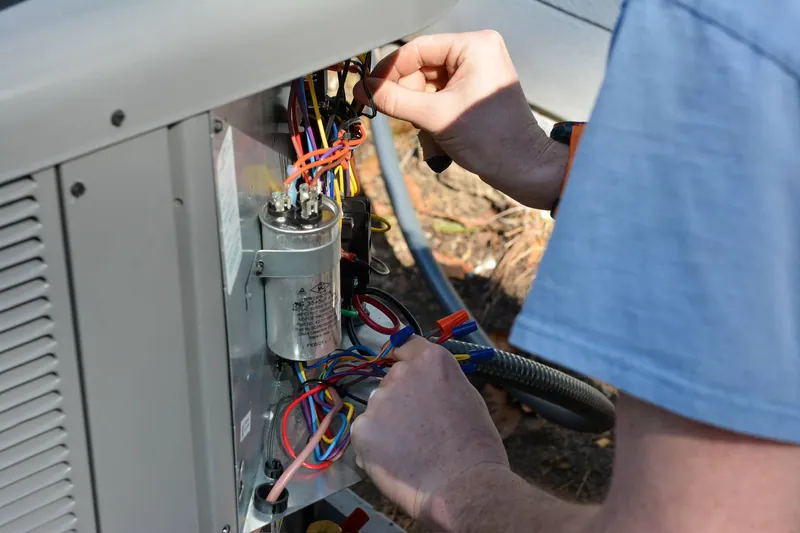
- Check electrical components — breakers, wiring, disconnect, capacitor, contactor. These are the most common causes of a sudden, complete failure, and they're often quick fixes.
- Inspect the compressor and motors — listening for sounds that indicate bearing failure, lockup, or other mechanical issues.
- Check refrigerant levels — low refrigerant means a leak somewhere, which causes the system to work harder and eventually fail.
- Inspect the evaporator and condenser coils — frozen evaporator coils are extremely common in Baldwin County because of our humid air and heavy filter loading.
- Check the thermostat and control board — making sure the system is actually receiving the right signals.
Common emergency repairs and what they typically cost
These are rough ranges for Baldwin County. Your actual cost depends on the specific equipment and the company's pricing:
- Capacitor replacement: $150-$350. This is the single most common emergency repair. Capacitors fail frequently, especially in the heat, and when they go, the system goes with them. It's usually a 20-minute fix.
- Contactor replacement: $150-$300. The contactor is the switch that tells the compressor to turn on. When it fails, the outdoor unit sits there doing nothing.
- Breaker or disconnect issues: $100-$250 depending on what needs replacing.
- Frozen evaporator coil (thaw + filter replacement + diagnosis): $150-$400. The fix itself is simple — the tech needs to determine why it froze (usually restricted airflow from a clogged filter, but sometimes low refrigerant).
- Refrigerant recharge (if it's a simple top-off, not a major leak): $200-$600 depending on refrigerant type and amount. R-410A is standard on systems made after 2010. Older R-22 systems cost significantly more because R-22 is no longer manufactured.
- Blower motor replacement: $400-$900. Less common as an emergency repair but possible if the motor seized.
- Compressor failure: $1,500-$3,000+ for the repair, but at this price point with an older system, you're usually better off discussing replacement in the morning rather than authorizing a major repair at 3 AM.
Add the after-hours diagnostic fee on top of these numbers — typically $100-$200 in the Baldwin County area, depending on the company and how far the tech has to drive.
Step 7: Prevention — How to Make Sure This Never Happens Again
You're reading this at 2 AM right now, so this section is for future you. Bookmark it. Come back when the crisis is over. Because the best emergency AC repair is the one you never need.
Schedule annual maintenance — before summer
This is the single most effective thing you can do. A professional tune-up catches failing capacitors, low refrigerant, corroded wiring, and dirty coils before they leave you sweating at 2 AM.
In Baldwin County, the time to schedule maintenance is February or March — before the cooling season starts in earnest. By May, every HVAC company in the area is slammed with repair calls. Get ahead of it.
Aim's Comfort Club is our maintenance plan — it includes annual tune-ups, priority scheduling (you go to the front of the line when something breaks), and discounts on repairs and parts. It's designed specifically for the kind of year-round AC usage Baldwin County demands. Call us at (251) 751-9908 to learn more.
Know the warning signs that your system is about to fail
ACs rarely die without warning. They usually tell you something's wrong for weeks before the 2 AM breakdown. Watch for:
- The system runs constantly but can't get the house to the set temperature. In a Baldwin County summer, your AC will run a lot — but it should still hit the set point and cycle off periodically. If it runs 24/7 and the house stays warm, something is struggling.
- Unusual noises. Clicking, grinding, screeching, buzzing, or rattling that's new or getting worse. These are components talking to you before they quit.
- Higher-than-normal energy bills without a change in usage. A system that's working harder to deliver the same cooling is a system heading toward failure.
- Weak airflow from the vents, even with a clean filter.
- Short cycling — the system turns on for a few minutes, shuts off, turns on again. This stresses every component and usually indicates a refrigerant issue, electrical problem, or oversized system.
- Water around the indoor unit. A small amount of condensation is normal. A puddle is not.
- The system is blowing warm or room-temperature air intermittently. It works sometimes, doesn't other times. This is often a failing compressor or an intermittent electrical connection.
Gulf Coast–specific threats to your AC system
Baldwin County's climate doesn't just make you work your AC harder — it actively attacks your equipment in ways that don't happen in other parts of the country.
Salt air corrosion. If you live in Spanish Fort near the causeway, along the Eastern Shore in Daphne, in Fairhope near the bluffs, or anywhere within a few miles of Mobile Bay, salt air is silently corroding your outdoor condenser's coils and electrical connections. Aluminum fins pit and degrade. Copper tubing develops pinhole leaks. Electrical contacts corrode and fail. Coastal-rated condensers with corrosion-resistant coatings last significantly longer in these areas. If your outdoor unit is standard (not coastal-rated), it needs more frequent professional cleaning to slow the damage.
Humidity strain. Your AC doesn't just cool — it dehumidifies. In Baldwin County, where summer relative humidity regularly sits between 80-95%, your system runs longer to remove moisture, which means more wear on the compressor, blower motor, and electrical components. A system that's properly sized and well-maintained handles this fine. A system that's borderline — aging, under-maintained, running on a dirty filter — buckles under the humidity load.
Hurricane season. Every year from June through November, Baldwin County faces the possibility of severe storms. Two things to know:
- A power outage isn't an AC problem. When the power comes back on, your system should restart on its own (most modern thermostats are programmed for this). If it doesn't, check the breaker. If the breaker trips repeatedly after a power restoration, call a professional — a power surge may have damaged a component.
- Post-storm debris can damage your outdoor unit. After any major storm, inspect the condenser for physical damage — bent fins, shifted position on the pad, impact from flying debris. Also check that the electrical disconnect (the small box near the outdoor unit) hasn't been damaged.
The 10-year rule
Most HVAC systems in Baldwin County will last 12-18 years with proper maintenance. But once a system crosses the 10-year mark, pay closer attention. Components start failing more frequently, efficiency drops, and the cost of repairs starts to add up.
Here's a practical rule: if a single repair costs more than half the price of a new system, it's usually time to replace. And if you've had two or more significant repairs in the past 12 months on a system that's over 10 years old, the math almost always favors replacement.
This isn't a sales pitch — this is what the numbers show. A new system costs $6,000-$14,000 depending on size and efficiency. Sinking $2,000 into a repair on a 14-year-old system that's likely to need another $1,500 repair next year doesn't make financial sense. A good HVAC company will lay out the numbers and let you decide.
You Shouldn't Have to Face a Baldwin County Summer Without AC
It's hot here. Really hot. Heat index values regularly climb past 105°F in July and August, and the National Weather Service issues heat advisories for Baldwin County multiple times each summer. AC failure on the Gulf Coast isn't a comfort issue — at a certain point, it's a health and safety issue.
If your AC just died and you need emergency AC repair in Baldwin County — Daphne, Spanish Fort, Fairhope, Foley, Gulf Shores, Robertsdale, or anywhere in between — call Aim Heating & Cooling at (251) 751-9908. We'll get a real technician to your home as fast as possible, diagnose the problem honestly, and give you straightforward options without the pressure.
And if your system is still running fine right now? You just read 3,000 words about what happens when it doesn't. Take 60 seconds and schedule a maintenance visit. Future you — the one who's sleeping soundly at 2 AM in a cool, dry house — will be grateful.
Call (251) 751-9908 or schedule service online to get ahead of the next Baldwin County summer.
Frequently Asked Questions
How much does emergency AC repair cost in Baldwin County?
Emergency AC repair costs vary based on the specific problem, but most after-hours repairs in Baldwin County run 1.5 to 2 times the cost of the same repair during business hours. Expect an after-hours diagnostic fee of $100-$200, plus the repair cost. Common emergency fixes like capacitor or contactor replacement typically run $150-$350, while more complex issues like compressor failure can cost $1,500 or more.
Should I call for emergency AC repair or wait until morning?
Call immediately if there are safety hazards (burning smell, gas smell, electrical sparking, water flooding), if vulnerable people are in the home (infants, elderly, those with medical conditions), or if indoor temperature is above 85°F and rising with no way to cool the house. If it's mild weather, everyone is healthy, or you found a simple fix like a tripped breaker, you can safely wait for a regular service call.
Why did my AC stop working in the middle of the night?
The most common causes of sudden AC failure are a blown capacitor, a tripped breaker, a clogged drain line triggering a safety shutoff, frozen evaporator coils from a dirty filter, or a failed contactor. Gulf Coast systems also face additional stress from humidity, salt air corrosion, and extended run times that accelerate component wear.
Can I fix my AC myself at 2 AM?
You can try a few quick checks: verify thermostat settings, reset a tripped breaker, replace a dirty air filter, and clear debris from the outdoor unit. These solve the problem about 30% of the time. For anything beyond these basics — electrical components, refrigerant issues, motor problems — you need a licensed technician.
How can I keep my house cool with no AC in Baldwin County's summer?
Keep windows closed (Gulf Coast humidity makes opening them counterproductive), use fans pointed directly at people rather than into empty rooms, apply cool wet towels to your neck and wrists, drink cold water, and move to the lowest floor of your house. If indoor temperature exceeds 90°F with vulnerable family members present, consider leaving for a cooled location.
How long does an emergency AC repair take?
Most common emergency repairs — capacitor replacement, contactor replacement, breaker issues — take 30 minutes to an hour once the technician is on-site. Frozen evaporator coils may need time to thaw before the tech can complete the diagnosis. More complex problems like compressor failure may require ordering parts, with a temporary fix or follow-up visit the next day.
Does Aim Heating & Cooling offer emergency AC repair in Baldwin County?
Yes. Aim Heating & Cooling provides emergency AC repair service throughout Baldwin County, including Daphne, Spanish Fort, Fairhope, Foley, Gulf Shores, and Robertsdale. Call us at (251) 751-9908 for same-day service.