Fairhope’s Pollen Season Is Destroying Your AC Filter — Here’s the Fix
When pollen is noticeable outside, watch the filter and the home’s actual conditions. Avoid assuming a fixed replacement deadline or diagnosing a problem from odor alone.
When outdoor pollen is noticeable around your Fairhope home, check whether the HVAC filter is loading differently too. Outdoor pollen on a car does not prove how much has entered the house or whether equipment is damaged.
Use this guide to record filter condition, moisture concerns and changes in cooling. Compare what you find with the previous inspection, and check sooner when loading increases.
Watch for Changes in Filter Loading
Check the filter’s instructions and inspect it monthly. If you notice heavier loading, inspect sooner and adapt the replacement routine. Do not assume a fixed three-week deadline applies to every filter or that light passing through it proves it is still suitable.
Record the filter model, installation date and what changed. Restricted airflow and poor fit can affect performance; a visible dusty filter does not identify a compressor or duct problem by itself.

A Musty Smell Needs Assessment
Report persistent odor and any visible water or damp materials. A smell alone cannot confirm mold, identify its location or establish that particles are being blown into every room.
The age or neighborhood of a home does not prove a duct defect. Note where and when the smell occurs and whether it follows a cooling cycle.
Do not switch the fan to continuous ON as a universal drying remedy. On some cooling systems, continued airflow over a wet coil can return moisture to the home. Follow the intended fan and humidity-control setup and ask about professional coil and drain assessment if needed.
Choose a Filter the System Can Accommodate
A higher MERV rating is not automatically a mistake, and a lower one is not automatically right. Check the actual filter model, fit and equipment requirements rather than generalizing from a brand or home’s construction year.
EPA’s filtration guide recommends MERV 13 or the highest efficiency compatible with the system. A technician can assess the fan and filter arrangement before an upgrade.
Neither a frequent replacement schedule nor an air purifier is a guaranteed solution for allergy symptoms. Discuss equipment compatibility with your HVAC maintenance provider; discuss ongoing symptoms with an appropriate health professional.
Keep the Fairhope visit focused on your actual home and equipment, including where the filter sits and how quickly it loads. If you have a maintenance agreement, confirm its included work.
Your Outdoor Unit Needs Attention Too
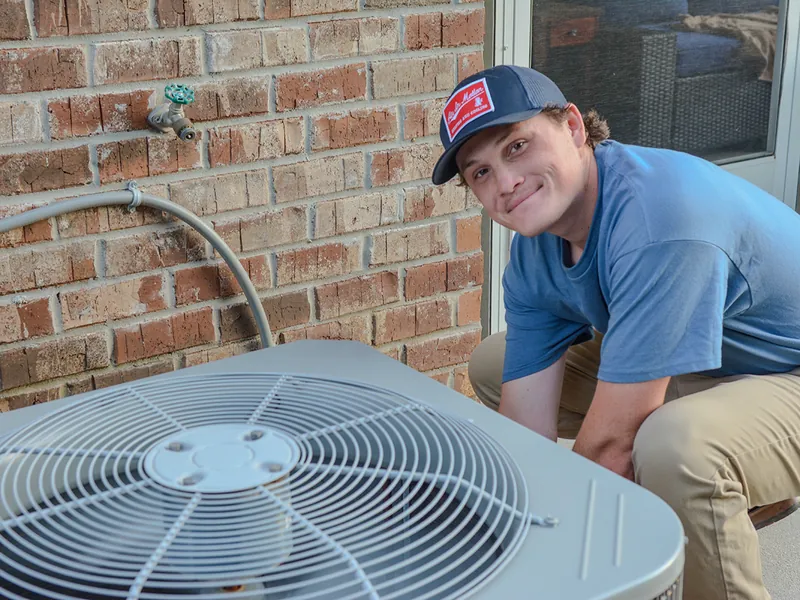
Look from outside for visible debris or obstructions around the condenser. Do not assume a yellow deposit identifies the cause of poor cooling or establishes damage.
Keep accessible surroundings clear according to the model’s required clearances. Do not reach inside the grille, remove panels or spray electrical parts. Ask about the exact manufacturer-approved cleaning procedure; if access or power isolation is uncertain, leave cleaning to the technician.
When Pollen Season Symptoms Mean Something Bigger
Report these observations without assuming pollen is the cause:
- Rooms that cool differently
- Water near the indoor unit or visible overflow
- Cooling that no longer maintains the chosen setting
- A filter that fits poorly, becomes damp or loads unusually quickly
Record timing and any recent changes. A technician can assess equipment, airflow and drainage. Allergy symptoms do not diagnose a duct leak, and filtration does not replace moisture control or appropriate ventilation.
How often should I change my AC filter during pollen season in Fairhope?
Inspect monthly and follow the filter’s instructions; inspect sooner when you observe heavier loading. Replacement depends on the filter and the home, not a fixed Fairhope pollen calendar. Confirm size and fit, and do not use the light-through test as the only measure.
Can pollen damage my HVAC system permanently?
Accumulated particles can contribute to dirty components or restricted airflow, but pollen on a surface does not prove permanent damage. Address filter and equipment care according to the instructions, and have changed performance assessed. Maintenance cannot guarantee that every failure will be prevented.
Should I keep my windows open or closed during pollen season?
When outdoor pollen is high, consider limiting how much enters through open windows while still meeting the home’s ventilation needs. Use the intended ventilation and filtration controls; continuous fan operation is not a universal humidity solution. Persistent stuffiness needs assessment rather than assuming cooling alone supplies fresh air.
For a cooling, filter-fit or moisture concern, call (251) 751-9908. Describe the symptoms and confirm the visit scope, diagnostic charge and same-day availability before scheduling.
LET’S TALK ABOUT YOUR HOME
Make the next step a clear one.
Tell us about your equipment, the problem or the project you’re planning.
Open 24/7 · 365 days a year · No after-hours fees
Call to confirm same-day availability. For an installation estimate, choose “Get A Free In-Home Estimate” in the booking menu.